
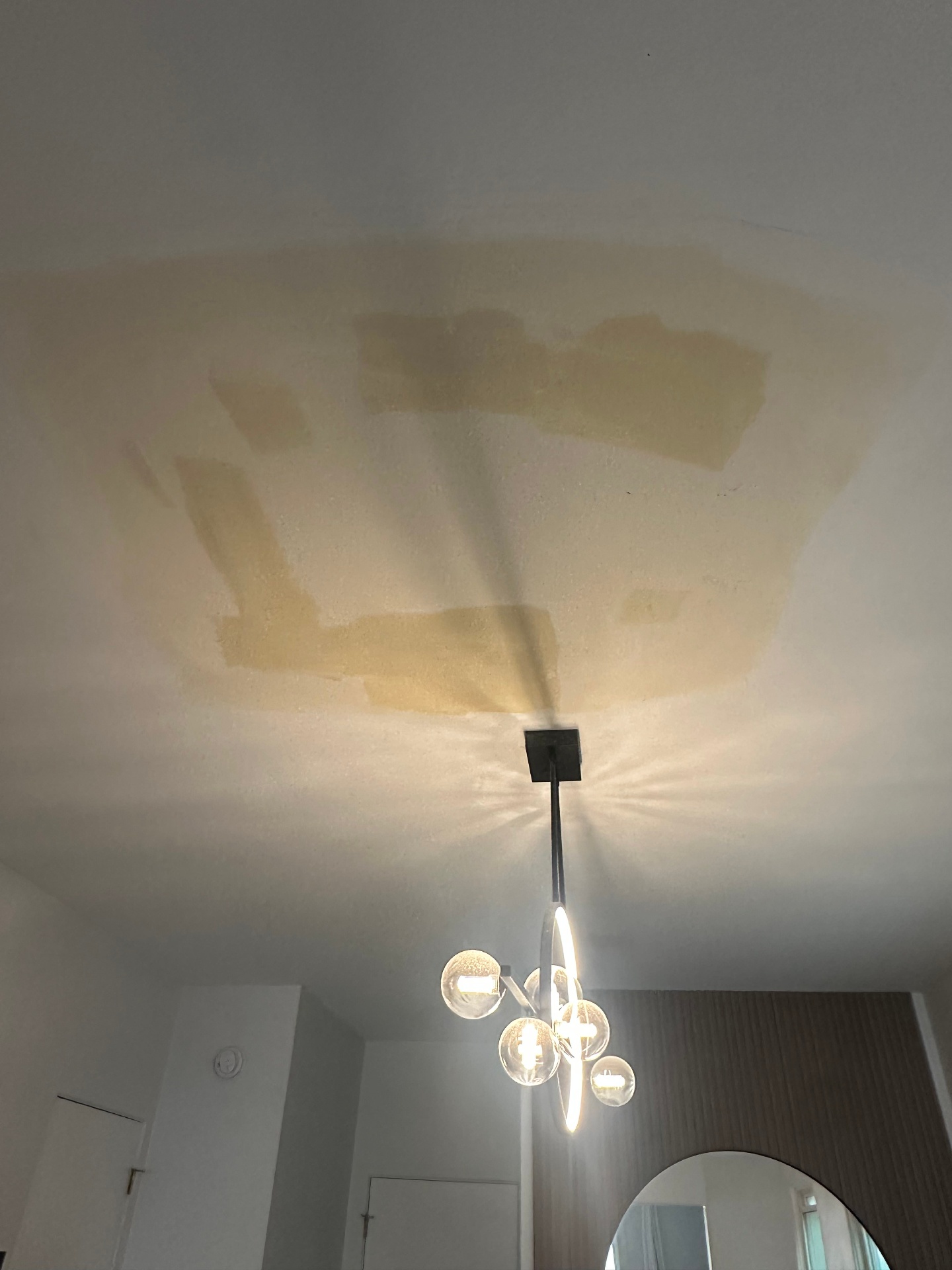
A brown ring on your ceiling is your house telling you something upstream failed. Before you touch it with a paint roller, you need to know exactly what leaked, whether it's still leaking, and whether the drywall itself is compromised. Here's the order we follow on every ceiling repair.
Step 1: Confirm the leak is fixed before any ceiling drywall repair
Painting over an active leak is the single most common way to double a repair bill. Common upstream sources:
- Second-floor bathroom - supply line to a toilet or vanity, wax ring, or shower pan.
- HVAC condensate line - a summer-only leak that vanishes each winter.
- Ice dam on the roof - a winter-only leak that vanishes each summer.
- Roof flashing around a chimney, vent, or valley.
- Old radiator or in-slab hydronic pipe.
If the source isn't obvious, cut a small inspection hole from below and look. In Highland Park and older Deerfield homes with plaster ceilings, we often find failed cast-iron waste stacks - those need a plumber before any drywall gets touched.
Step 2: Assess the water-damaged drywall ceiling
Once the leak is stopped, evaluate the ceiling:
- Just a stain, ceiling is still firm and flat → stain-block primer + repaint may be enough.
- Ceiling is soft to a fingertip or slightly sagging → cut out the affected section, dry the cavity, replace the drywall.
- Ceiling has visible mold or a musty smell → remediation-grade removal with containment and negative air.
- Insulation above the drywall is wet → remove and replace it. Wet fiberglass never fully dries.
Step 3: Cut the damaged ceiling drywall back to clean, dry material
We cut back to the nearest joists on each side of the damaged area, in clean rectangular cuts. This gives us solid framing to fasten the new drywall patch to and stops the repair from telegraphing through a random shape later.
Step 4: Dry the cavity, then rebuild the ceiling drywall
Before the new board goes up, the cavity has to be dry - we verify with a moisture meter, not by eye. New insulation goes in, then the drywall patch, then three coats of joint compound feathered wide enough that the transition is invisible in raking light. For the finish coat we typically call it a Level 4 unless the ceiling is under strong grazing light - see our finishing page, and the guide to Level 4 vs Level 5 drywall finish if the ceiling sits under grazing light.
Step 5: Match the ceiling drywall texture
This is where most DIY repairs fall apart. If the ceiling is smooth, we skim wide and sand flat. If it's knockdown, orange peel, or (still common in older Illinois homes) popcorn, we match by spray or hand - details on our texture matching page.
Step 6: Prime the entire water-stained ceiling, not just the patch
Water stains bleed through latex paint. Use an oil- or shellac-based stain-blocking primer over the patch and a coat of drywall primer across the whole ceiling. Then paint the entire ceiling - spot painting almost never blends on ceilings because ceiling paint yellows unevenly over the years.
When to call a water-damaged ceiling repair pro immediately
- The ceiling is bowing more than a half inch.
- You see mold or smell mildew.
- The leak came from a sewer line.
- The ceiling is above a finished basement or family room where dust control matters.
For anything in those categories, our water-damaged drywall repair crews come out same or next day for water damaged ceiling repair in Highland Park, Deerfield, Buffalo Grove, and Naperville. You can request a free drywall repair estimate or contact us here.
How to dry a ceiling after a water leak
Drying comes before any repair. Pull back or remove wet insulation, open the cavity from below if the drywall is staying, and run air movers plus a dehumidifier for 48 to 72 hours. Confirm with a moisture meter that both the framing and the remaining board read at the same level as an undamaged part of the ceiling. A wet drywall ceiling that is closed up early traps moisture against the joists and turns a one-day patch into a mold job.
Roof leak drywall damage vs plumbing leak drywall damage
Roof leaks and ice dams stain outward from an exterior wall or a valley, show up after storms and thaws, and often soak insulation across several joist bays. Plumbing leaks appear directly under a bathroom or laundry, repeat every time the fixture is used, and stay tight to one area. The distinction changes the repair: roof leak drywall damage usually means insulation replacement and a wider cut, while a supply-line drip is often a single-bay patch. Either way the water source gets fixed first, then we move to ceiling drywall repair.
How much does water damage ceiling repair cost?
In Illinois, a stain-only ceiling with a stain-blocking primer and repaint typically runs a few hundred dollars. A cut-out and replace repair of one to two joist bays, including drying, insulation, three coats, texture match, and full-ceiling paint, usually lands in the mid hundreds to low thousands. Mold containment or a full ceiling replacement moves the number up from there. Detailed ranges are on our drywall repair cost guide and the ceiling repair cost breakdown. For a number on your own ceiling, request a free estimate and send a photo of the stain.
Repairing a water-stained drywall ceiling that is still firm
If the board is dry and solid and you only have a brown ring, you do not need to open the ceiling. Sand the raised paper lightly, seal the stain with an oil- or shellac-based blocker, and repaint the full ceiling plane so sheen and color match. Skipping the blocker is why stains bleed back through within a few weeks.
How to repaint a water damaged ceiling so the stain never returns
Repainting is its own step, and doing it in the wrong order is why so many ceilings stain twice. Scrape any flaking or blistered paint back to a sound edge, sand the raised paper fibers flat, and vacuum the dust. Seal the affected area with an oil- or shellac-based stain blocker - latex 'stain-hiding' paint will not hold back tannins from roof or framing water. Then prime the whole plane and roll two full coats of ceiling paint corner to corner. Never spot-paint: ceiling paint yellows unevenly, so a perfectly executed patch still shows as a bright rectangle.
Water damage hole in a ceiling versus a stain
When water sits long enough, the gypsum core loses strength and the ceiling opens up - either it sags and tears under its own weight, or someone pokes it and it collapses. A hole means the board is no longer structural and there is no sealing-and-painting shortcut. We cut the opening square to the joists on both sides, dry the cavity, and set a new panel; the process is the same one on our drywall hole and patch repair page, with drying added in front of it. If the ceiling is bowing at all, keep people out from under it until it is opened.
Wet ceiling drywall repair: repair or replace the whole ceiling?
Patch when the wet area is confined to one or two joist bays, the rest of the ceiling reads dry on a meter, and the texture is something we can match. Replace the full ceiling plane when water tracked across several bays, when the ceiling is a pre-1980 popcorn that will not survive partial disturbance, or when there are already three or four old patches in the same room - at that point a new plane costs less than chasing an invisible blend. We give you both numbers on the estimate rather than deciding for you.
Water damage on a tectum or acoustic ceiling
Tectum and other wood-fiber acoustic panels show up in Illinois schools, churches, and mid-century commercial spaces, and they do not behave like drywall. Wet panels swell, lose acoustic rating, and cannot be sanded back, so damaged tiles are replaced rather than repaired and the surrounding grid or deck gets checked for the leak path. Where the panels butt into gypsum bulkheads we rebuild the drywall side normally - see commercial drywall for the full-building version of that work.
Frequently Asked Questions
Can I just paint over a water stain?
+
Only if you're 100% certain the leak is fixed and the ceiling is firm and dry. Use a stain-blocking primer under your topcoat. If the ceiling is soft anywhere, the drywall needs to come out.
How do I know if there's mold above the drywall?
+
Musty smell, black speckling around the stain, or peeling paint are strong indicators. If in doubt, cut a small inspection hole and check. Mold requires proper containment, not just paint.
How long does the drywall need to dry before repair?
+
We verify with a moisture meter - usually 48-72 hours after the leak is stopped, with fans running. Rebuilding wet is how mold problems start.
How do you dry a ceiling after a water leak?
+
Remove wet insulation, open the cavity if the board is staying, and run air movers with a dehumidifier for 48-72 hours. Verify dryness with a moisture meter against an undamaged section before closing anything up.
Does wet drywall on a ceiling always need to be replaced?
+
No. If it is still firm, flat, and dries fully, sealing and repainting is enough. If it is soft to a fingertip, sagging, or was wet for more than a couple of days, we cut it out back to the joists.
How much does water damage ceiling repair cost?
+
A stain-only repaint is typically a few hundred dollars. Cutting out and rebuilding one or two joist bays with drying, texture match, and full-ceiling paint usually runs from the mid hundreds into the low thousands in Illinois.
What does a roof leak look like on a drywall ceiling?
+
Stains that spread from an exterior wall line, appear after heavy rain or a winter thaw, and cover multiple joist bays usually point at roofing or an ice dam rather than plumbing.
Will insurance cover a water-damaged ceiling?
+
Sudden and accidental leaks (a burst pipe, an overflowing tub) are usually covered. Long-term seepage and maintenance issues typically aren't. We provide documentation for the adjuster either way.
Do you match popcorn ceiling texture?
+
Yes, though we always ask about age - popcorn installed before 1980 may contain asbestos and requires testing before disturbance.
How do you repaint a water damaged ceiling?
+
Scrape loose paint, sand the raised paper, seal with an oil- or shellac-based stain blocker, prime the whole plane, then roll two coats of ceiling paint corner to corner. Spot-painting shows because ceiling paint yellows unevenly.
What causes a water damage hole in a ceiling?
+
Prolonged saturation destroys the gypsum core, so the board sags and tears under its own weight. A hole means the panel is no longer structural and has to be cut out and replaced, not sealed.
Should a wet drywall ceiling be repaired or fully replaced?
+
Patch when the damage is confined to one or two joist bays and the texture is matchable. Replace the plane when water tracked across several bays, the ceiling is pre-1980 popcorn, or it already carries several old patches.
Can water damaged tectum panels be repaired?
+
No. Wood-fiber acoustic panels like tectum swell and lose their acoustic rating when wet, so damaged panels are replaced and the leak path through the deck or grid is corrected.
How soon should a leaking ceiling be looked at?
+
Within a day or two. Drywall that stays wet past about 48 hours moves from a simple patch into mold territory, which changes both the scope and the cost.