The moment you ask a drywall finisher about 'levels,' you're stepping into a six-tier system the industry uses to describe how prepared a wall is for its final coat. It's defined by the Gypsum Association and the AWCI, and it's the single best way to write an unambiguous scope of work.
The six drywall finish levels explained
- Level 0 - Board is hung, nothing else. Temporary construction only.
- Level 1 - Tape embedded, no finishing. Above ceilings, mechanical rooms.
- Level 2 - One coat over tape and fasteners. Garages, warehouses.
- Level 3 - Two coats. Ready for heavy texture or wall covering.
- Level 4 - Three coats, sanded smooth, ready for paint or light texture. The residential default.
- Level 5 - Level 4 + a full skim coat across the entire surface. The premium finish.
What is a Level 4 drywall finish?
A Level 4 drywall finish is three coats of joint compound over the tape, fasteners, and beads, sanded smooth and ready for primer and paint. It is the standard smooth finish in nearly every Illinois home: no skim coat over the field of the board, just the seams and screws built out and feathered flat. A Level 4 wall texture reads perfectly flat under normal room lighting, which is why it is the residential default for flat and eggshell paint.
What is a Level 5 drywall finish?
A Level 5 drywall finish is a Level 4 wall plus a thin skim coat of compound applied across the entire surface, then sanded and primed. Because the paper facing and the joints end up under the same material, the whole plane takes primer and paint at one porosity. In the Gypsum Association GA-214 standard this is the highest level 5 gypsum board finish, and it is what you specify for gloss paint, dark colors, or walls in strong window light.
Level 3 vs Level 4 drywall finish
Level 3 is two coats instead of three and is meant to disappear under heavy texture or wall covering. Level 4 is three coats sanded smooth for paint. If you are painting the wall directly, Level 3 is not enough - the joints will telegraph. If you are spraying knockdown or orange peel, Level 3 saves labor without costing you anything visually. Our texture matching work starts from whichever level the existing wall was built to.
When you actually need a Level 5 drywall finish
Level 5 exists to solve one problem: joint photographing. Under raking light - the low-angle light coming through big windows around sunrise and sunset - a Level 4 wall can show subtle differences between the paper facing of the drywall and the joint compound over the seams. A skim coat evens out the entire wall to the same porosity, and the joints disappear.
You want Level 5 when:
- Walls receive strong raking light from tall or lakeside windows.
- The finish paint is glossier than eggshell.
- The wall color is dark, saturated, or metallic.
- You're using specialty finishes: Venetian plaster, limewash, or high-gloss lacquer.
You can happily specify Level 4 when the wall is going into a matte or eggshell paint, isn't in raking light, and is in a functional room (utility, closet, secondary bedroom).
Why raking light makes a Level 5 drywall finish matter here
In Lake Bluff and Lake Forest, we hang and finish a lot of walls near tall east-facing windows overlooking the lake. That morning light is famously unforgiving. Older Highland Park homes with restored millwork often get high-gloss trim next to matte walls - another setup where the eye picks up any joint that isn't skimmed. Newer builds in Naperville and Plainfield with two-story great rooms get the same treatment. If the wall or ceiling you are skimming was previously repaired, read the water damaged ceiling repair steps first - a skim coat over drywall that never dried will fail.
What a Level 5 drywall skim coat actually involves
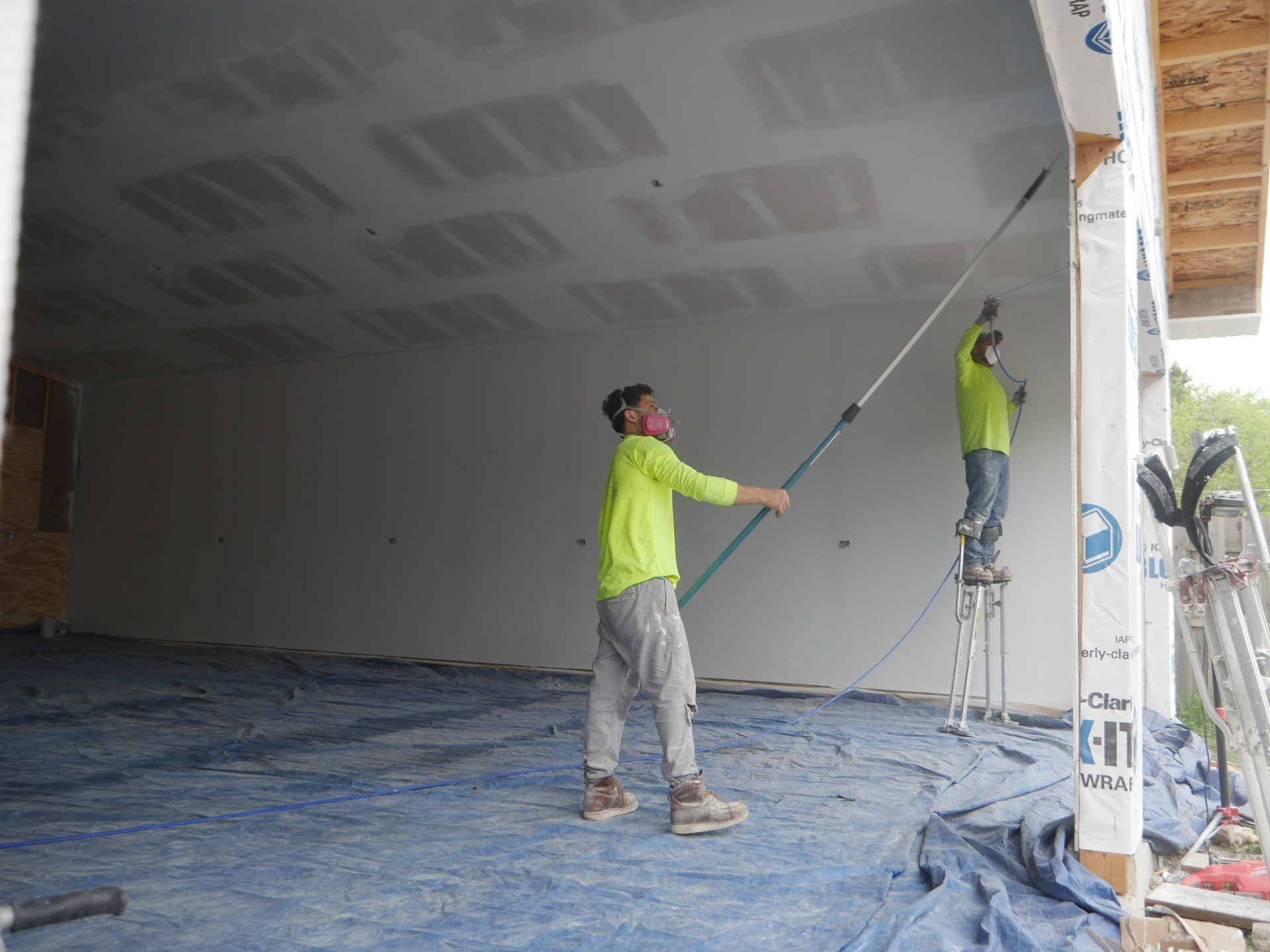
It's a thin coat of diluted joint compound (or a proprietary skim product) rolled or sprayed across the entire wall and knocked down flat with a wide blade. Once it dries, the whole surface sands to the same texture. Then it's primed with a high-solids primer. See the Gypsum Association technical library for the industry-standard GA-214 specification.
How to do a Level 5 drywall finish, step by step
- Finish to a complete Level 4 first: three coats over tape, fasteners, and beads, sanded flat.
- Thin all-purpose or lightweight compound to a heavy-cream consistency.
- Roll or spray the skim across the full plane, one wall at a time so nothing sets up.
- Knock down immediately with a 14 to 24 inch blade, holding a low angle and overlapping passes.
- Let it dry fully, then sand with a 220-grit screen and a raking light held against the wall.
- Prime with a high-build or high-solids drywall primer before any topcoat.
Level 4 and Level 5 in plaster, plasterboard, gypsum board, and sheetrock terms
The levels are written for gypsum board, so a level 4 gypsum board finish and a Level 4 sheetrock finish are the same specification - Sheetrock is simply the USG brand name, as we explain in the sheetrock vs drywall guide. A level 5 plasterboard finish means the same thing in British and Canadian specs. Where people go wrong is with plaster: a level 5 plaster finish or a veneer plaster system is a different material with its own standard, even though the visual result is similar to a level 5 finish on drywall. If your architect wrote 'level 5 plaster,' confirm whether they want a skim-coated gypsum board wall or true veneer plaster before anyone prices it.
Level 4 drywall finish standards and inspection
Level 4 finish standards come from GA-214, and inspection is done the way the standard describes: from the position and under the lighting the finished wall will normally be viewed in, after primer, not with a work light pressed against the board. A level 4 drywall finish inspection checks that joints and fastener heads are covered by three coats, feathered smooth, free of ridges, tool marks, and visible sanding scratches. Any critical-light complaint that survives a compliant Level 4 is a specification problem, not a workmanship problem - the answer is Level 5.
How to specify a Level 5 drywall finish on your estimate
Write it exactly like this on your scope: 'Level 5 finish per GA-214, full skim coat, PVA or high-build primer, ready for [paint sheen].' That leaves zero ambiguity. Our taping and mudding and drywall finishing services both quote to GA-214 by default, and we call out the level in writing on every estimate.
Level 4 vs Level 5 drywall: the cost difference
Level 5 typically adds 20-40% to the finishing portion of a job. On a full residential drywall project, that usually works out to a few thousand dollars for a whole house - trivial compared to the paint and lighting spend it's meant to protect. Request a free drywall finishing estimate and we will price Level 4 and Level 5 side by side so you can compare.
Frequently Asked Questions
What is a Level 4 drywall finish?
+
Three coats of joint compound over tape, screws, and beads, sanded smooth and ready for primer and paint. No skim coat across the field of the board. It is the standard smooth finish in residential drywall.
What is a Level 5 drywall finish?
+
A Level 4 finish plus a full skim coat over the entire surface, sanded and primed, so the paper and the joints take paint at the same porosity. It is the highest finish in the GA-214 standard.
What is the difference between Level 3 and Level 4 drywall?
+
Level 3 is two coats and is intended to go under heavy texture or wall covering. Level 4 is three coats sanded smooth for direct paint. Painting straight over Level 3 will show the joints.
Is Level 5 worth it if I'm painting eggshell?
+
Usually not for eggshell in normal light. It's worth it if the room has strong window light or a dark color that will read differently across primer vs joint compound.
How much more does a Level 5 skim coat cost?
+
Level 5 typically adds 20-40% to the finishing portion of a job, which on a whole house is usually a few thousand dollars over a Level 4 finish.
Can you upgrade an already-finished Level 4 wall to Level 5?
+
Yes - we skim over the existing Level 4, sand, and prime. It's a common request after a homeowner sees the room in morning light for the first time.
Do you do Level 5 on ceilings?
+
Yes, especially in kitchens and living rooms with recessed lighting that grazes the ceiling. See our ceiling drywall page.
Does Level 5 change the paint spec?
+
It changes the primer. We recommend a high-solids drywall primer or a Level-5 specific PVA over the skim coat so the paint sheen reads uniformly.
What does level 4 sheetrock mean?
+
The same thing as a Level 4 drywall or level 4 gypsum board finish. Sheetrock is the USG brand name for gypsum board, so the GA-214 finish levels apply identically.
Is a level 5 plasterboard or gypsum board finish the same as level 5 drywall?
+
Yes. Plasterboard and gypsum board are the same product as drywall, so a level 5 plasterboard finish is a full skim coat over a completed Level 4.
Is a level 5 plaster finish the same as level 5 drywall?
+
No. Veneer or traditional plaster is a different material with its own standard. The look is similar, but the scope, materials, and price are not - confirm which one your spec means before pricing.
What are the 5 levels of drywall finish?
+
There are actually six, Level 0 through Level 5: bare board, taped only, one coat, two coats, three coats sanded smooth, and Level 4 plus a full skim coat.
How is a level 4 drywall finish inspected?
+
Under the lighting and from the viewing position the finished wall will normally be seen in, after primer. Joints and fasteners must be covered with three coats and feathered smooth, with no ridges, tool marks, or sanding scratches.
What is a level 4 skim coat?
+
Strictly speaking there isn't one - a skim coat over the full surface is what makes a wall Level 5. People usually mean the third, wide feather coat over the joints on a Level 4 wall.
What is a level 4 smooth finish versus a level 4 texture?
+
A level 4 smooth drywall finish is sanded flat and painted directly. Level 4 with texture means the same three coats followed by a sprayed orange peel or knockdown pattern.