
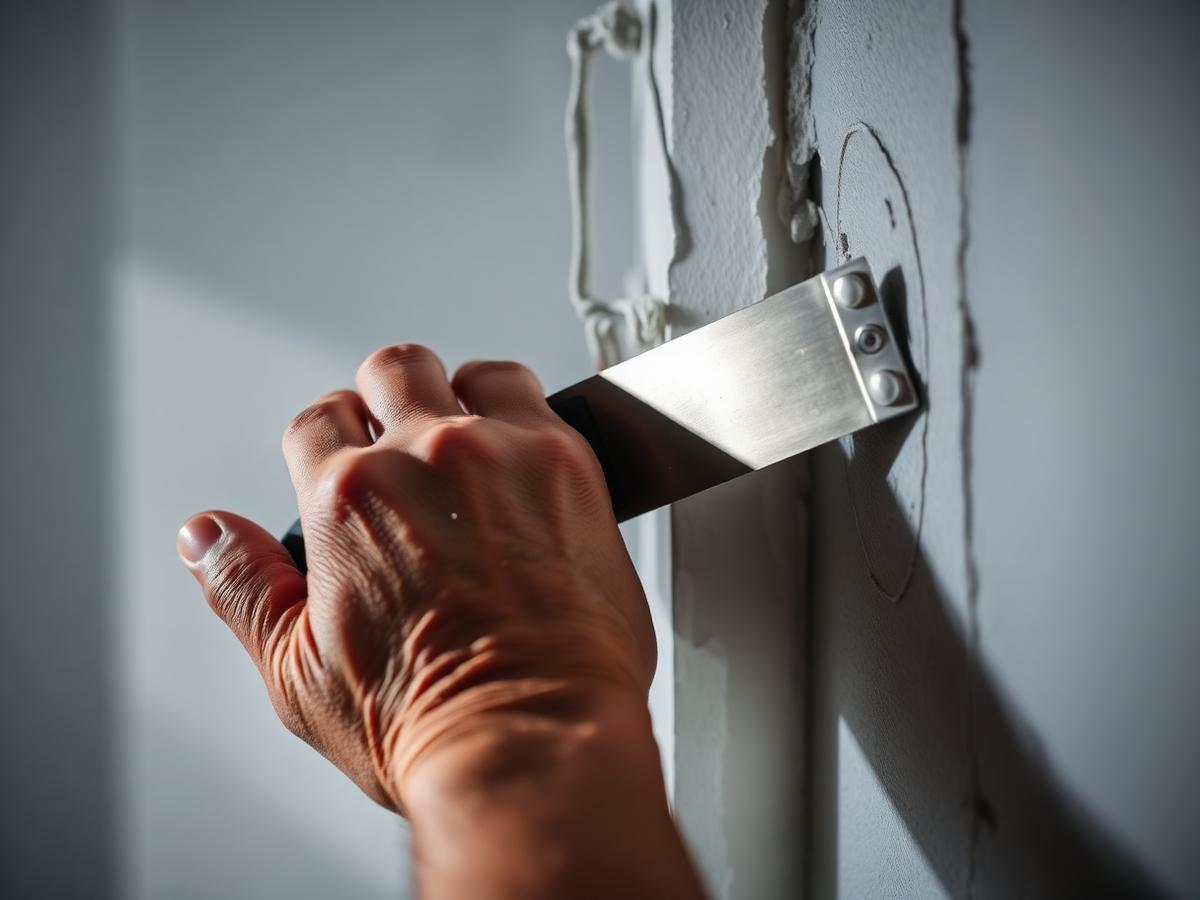
The hardest part of a good drywall repair isn't the patch - it's making the patch look like it was always there. Get the texture wrong by 10% and the repair jumps out under any decent overhead light. Get it right and even the homeowner can't find it a month later.
Almost every North Shore home falls into one of four texture families.
1. Smooth drywall texture (Level 4 or Level 5 finish)
Common in newer builds in Deerfield and Buffalo Grove and in modern renovations across Highland Park. The 'match' is a skim coat, sanded flat, primed to the same porosity as the surrounding wall. If the surrounding wall is Level 5, our patch has to be Level 5 too - see the Level 4 vs Level 5 guide for why that matters.
2. Orange peel drywall texture
The most common wall texture in the market. Small, tight splatters that look like - you guessed it - orange skin. We match it with a hopper gun, thinned all-purpose mud (to the consistency of pancake batter), and a specific nozzle-to-wall distance we calibrate on cardboard first. The trick is not just the splatter - it's blending the edge of the new spray into the old texture, which we do with a light knockdown pass on the perimeter only.
3. Knockdown drywall texture
Orange peel that's been flattened with a wide knockdown knife 5-15 minutes after spraying. Two variables have to match: the spray pattern underneath and the knockdown timing. On repairs, we spray the patch a shade heavier than the original, then knock down at the same timing we used on the cardboard sample. If we knock down too early, the mud smears. Too late, and the flats are shiny while the original wall is matte.
4. Hand-troweled plaster and skip-trowel drywall textures
This is the signature texture in restored Lake Forest and Highland Park homes and older Lake Bluff properties. Skip-trowel isn't sprayed - it's applied by hand with a specific trowel angle and pressure, leaving asymmetric flat patches surrounded by ridged mud. Matching it is entirely about mimicking the original craftsman's hand. We usually take a photo of a clean section and reference it while working.
For genuine 1920s and 1930s plaster (not drywall), we often skim over the drywall patch with a thin plaster coat so the surface hardness and reflectivity match. Background on the material difference is on the Wikipedia plaster page.
Drywall texture matching mistakes that give a patch away
- Mud is too thick, so the splatter reads chunkier than the original.
- Sprayed too close, so the pattern is dense in a small circle instead of feathered.
- Knocked down too hard, so the peaks flatten more than the surrounding wall.
- Primer wasn't used, so the new mud reads flatter than aged paint next to it.
- The perimeter blend line runs straight - the eye picks up straight lines instantly. We always blend on an irregular perimeter.
Priming and paint sheen matter as much as drywall texture
A perfect texture match still telegraphs if the paint sheen doesn't match. We always prime the patch and spot-paint out to a natural break - corner, edge of a window casing, or the full wall for anything obvious. For dark or saturated colors, plan to repaint the full wall.
When we ask for a drywall texture sample
For unusual textures - hand-swirled ceilings, custom Venetian, or a highly specific knockdown - we sometimes ask for a scrap piece of the original board from an inconspicuous location so we can practice off-site. It sounds like overkill, but it turns a $600 patch into a $600 patch that actually looks invisible.
Full details on our approach are on the texture matching and drywall finishing pages.
Frequently Asked Questions
Can any texture be matched?
+
Almost. Very old, hand-worked plaster with 90 years of paint layers is the hardest, and even those we can get to within 5% of invisible with proper prep.
Why did my last patch stand out under the ceiling light?
+
Almost always one of three things: spray pattern doesn't match, primer was skipped, or the perimeter was blended on a straight line. The eye finds straight blend lines instantly.
Do you match popcorn ceiling?
+
Yes, with the caveat that popcorn installed before 1980 may contain asbestos and must be tested before disturbance. See our ceiling drywall repair page.
How long does texture matching add to a repair?
+
Usually a day or two - spray, dry, knockdown timing, and a second visit to prime once mud is fully cured.