
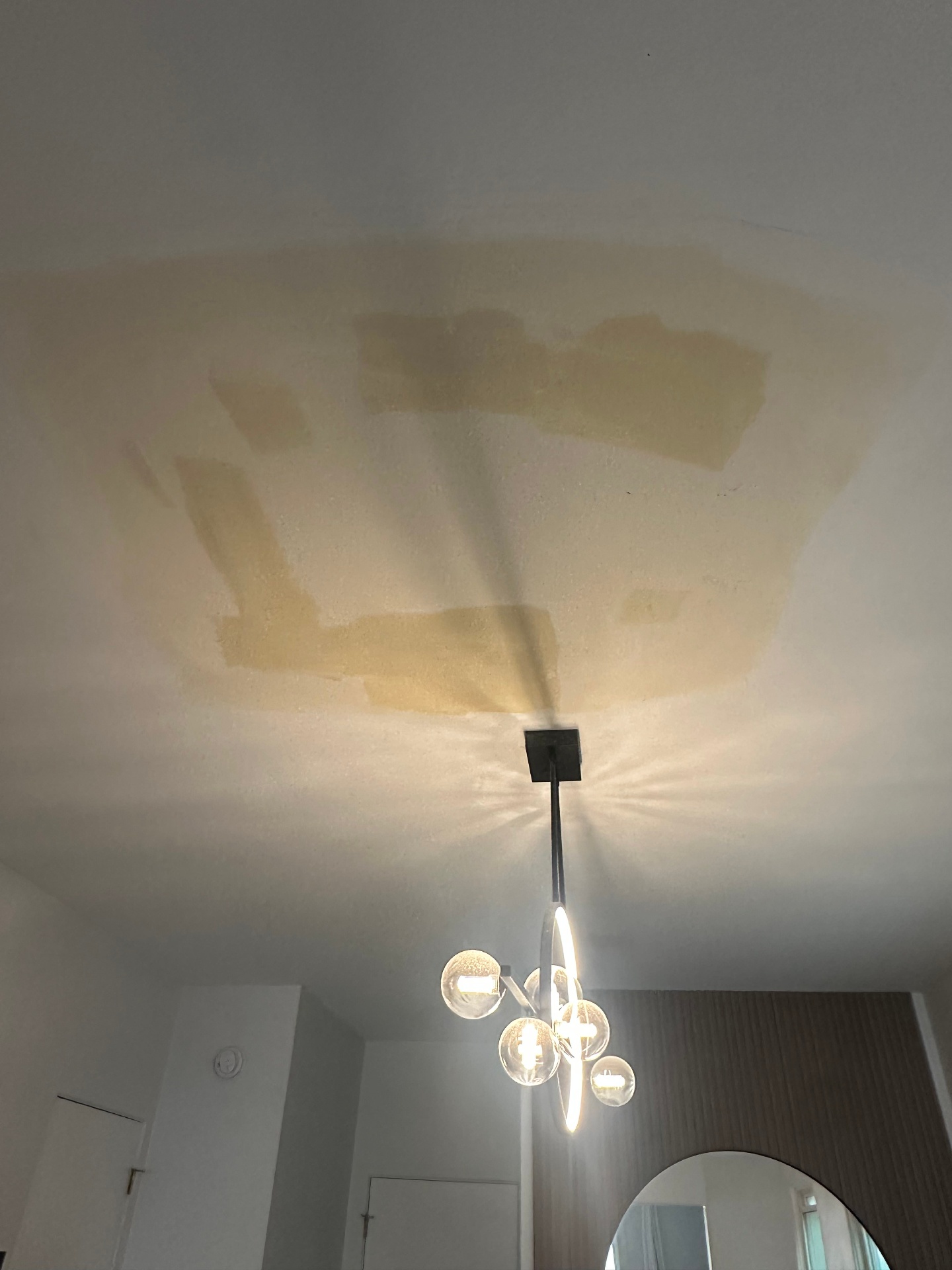
Illinois ceilings take water damage from three specific sources more than any others: ice dams in January and February, second-floor bathroom leaks that show up months after they started, and HVAC condensate lines that leak only in summer. Each one leaves a different pattern on the ceiling, and each one needs a different first step before any ceiling drywall repair starts. Getting the diagnosis right is what separates a $500 repair from a $2,400 rebuild. This page covers the Illinois-specific causes; for the full step-by-step method - drying, cutting back, texture matching, and repainting - follow our water damage ceiling repair guide.
Illinois ice dam ceiling damage - the January and February pattern
Ice dams form when heat escaping through the attic melts snow on the roof, the meltwater runs down to the cold eave, and refreezes into a ridge of ice. Water backs up behind that ridge, gets under shingles, and drips into the top-floor ceiling. In Illinois - especially in Highland Park, Lake Forest, and Lake Bluff - we see this every winter, and the damage pattern is distinctive: brown stains along exterior walls, most concentrated near roof-eave lines, appearing only in winter.
Before touching the ceiling, the roof and attic insulation need to be addressed - otherwise the same ceiling gets damaged again next January. Attic air sealing and R-49 to R-60 insulation is the long-term fix; ice melt cables at the eave are the short-term one.
Second-floor bathroom leaks - the year-round Illinois pattern
The most common water-damaged ceiling call we get in Illinois is a first-floor ceiling stain directly under a second-floor bathroom. Common sources: toilet wax ring failure, tub or shower pan crack, vanity supply line leak, shower valve stem leak. These leak slowly and often show up months after they started - the paper facing of the drywall absorbs water long before it drips through visibly. A plumber has to find and stop the source before drywall work starts. Full water-damaged drywall repair protocol is on our service page.
HVAC condensate ceiling leaks - the summer-only pattern
Illinois summers push AC condensate volumes high enough that a clogged or disconnected condensate line will overflow the drain pan and drip into a ceiling below the air handler. Diagnostic: the stain shows up in June or July, disappears in October, and comes back next summer. Fix the condensate line first - clean the drain, check the pan, replace the trap - then repair the ceiling. This is a common source in Deerfield and Buffalo Grove homes with attic-mounted air handlers.
The six-step water-damaged ceiling repair process
- Confirm the leak source is identified and stopped - never rebuild over an active leak.
- Assess the drywall: firm and dry = stain-block primer may be enough; soft or sagging = cut it out.
- Cut damaged drywall back to the nearest joists on each side, in clean rectangular cuts.
- Verify the cavity is dry with a moisture meter, not by eye. Replace wet insulation - wet fiberglass never fully dries.
- Install new drywall panel, tape seams, three coats of joint compound feathered wide.
- Match ceiling texture, prime the entire ceiling (not just the patch), and repaint.
Why you have to prime the entire ceiling, not just the patch
Water stains bleed through latex paint. And ceiling paint yellows unevenly over time, so spot-painting almost never blends. The right approach on an Illinois ceiling repair: oil- or shellac-based stain-blocking primer over the patch, then a coat of drywall primer across the whole ceiling, then repaint the entire ceiling in the same product. Spot repairs on a 15-year-old ceiling almost always show.
What water-damaged ceiling repair costs in Illinois
A ceiling patch under 4 sq ft without water damage runs $425-$850 in Illinois in 2026. A full ceiling section after a plumbing leak runs $950-$2,400+ depending on how much has to come out, whether insulation is wet, and whether the ceiling needs a full repaint after primer. Full range breakdown lives on our drywall repair cost in Illinois pillar. Homeowner's insurance usually covers sudden-and-accidental leaks but rarely covers long-term seepage.
When to call an Illinois pro immediately
- Ceiling is bowing more than a half inch - risk of collapse.
- You see mold or smell mildew above the ceiling.
- The leak came from a sewer line - biohazard, not a normal water leak.
- The leak is above a finished basement or family room where dust control matters.
Frequently Asked Questions
Can I just paint over a water-stained ceiling?
+
Only if you're 100% certain the leak is fixed and the ceiling is firm and dry. Use a stain-blocking primer under your topcoat. If the ceiling is soft anywhere, the drywall needs to come out - painting over soft drywall traps moisture and grows mold.
How do Illinois ice dams damage ceilings?
+
Meltwater from a snow-covered roof backs up behind ice ridges at the eaves, gets under shingles, and drips into the top-floor ceiling. Damage pattern is stains along exterior walls near roof-eave lines, appearing only in winter.
How long does the drywall ceiling need to dry before repair?
+
We verify with a moisture meter, usually 48-72 hours after the leak is stopped with fans running in the space. Rebuilding a wet ceiling is how mold problems start.
Will Illinois homeowner's insurance cover a water-damaged ceiling?
+
Sudden-and-accidental leaks - a burst pipe, an overflowing tub, an ice-dam event - are usually covered under Illinois homeowner's policies. Long-term seepage and deferred-maintenance leaks typically aren't. We provide adjuster-ready documentation either way.
Do you match popcorn or textured ceilings in older Illinois homes?
+
Yes. Popcorn installed before 1980 may contain asbestos and requires testing before disturbance - we handle that step. Knockdown, orange peel, and hand-troweled textures are all matched routinely.
How much does water-damaged ceiling repair cost in Illinois?
+
A ceiling patch under 4 sq ft without water damage runs $425-$850 in Illinois. Full ceiling sections after a plumbing leak run $950-$2,400+. Full ranges on our drywall repair cost in Illinois pillar.