
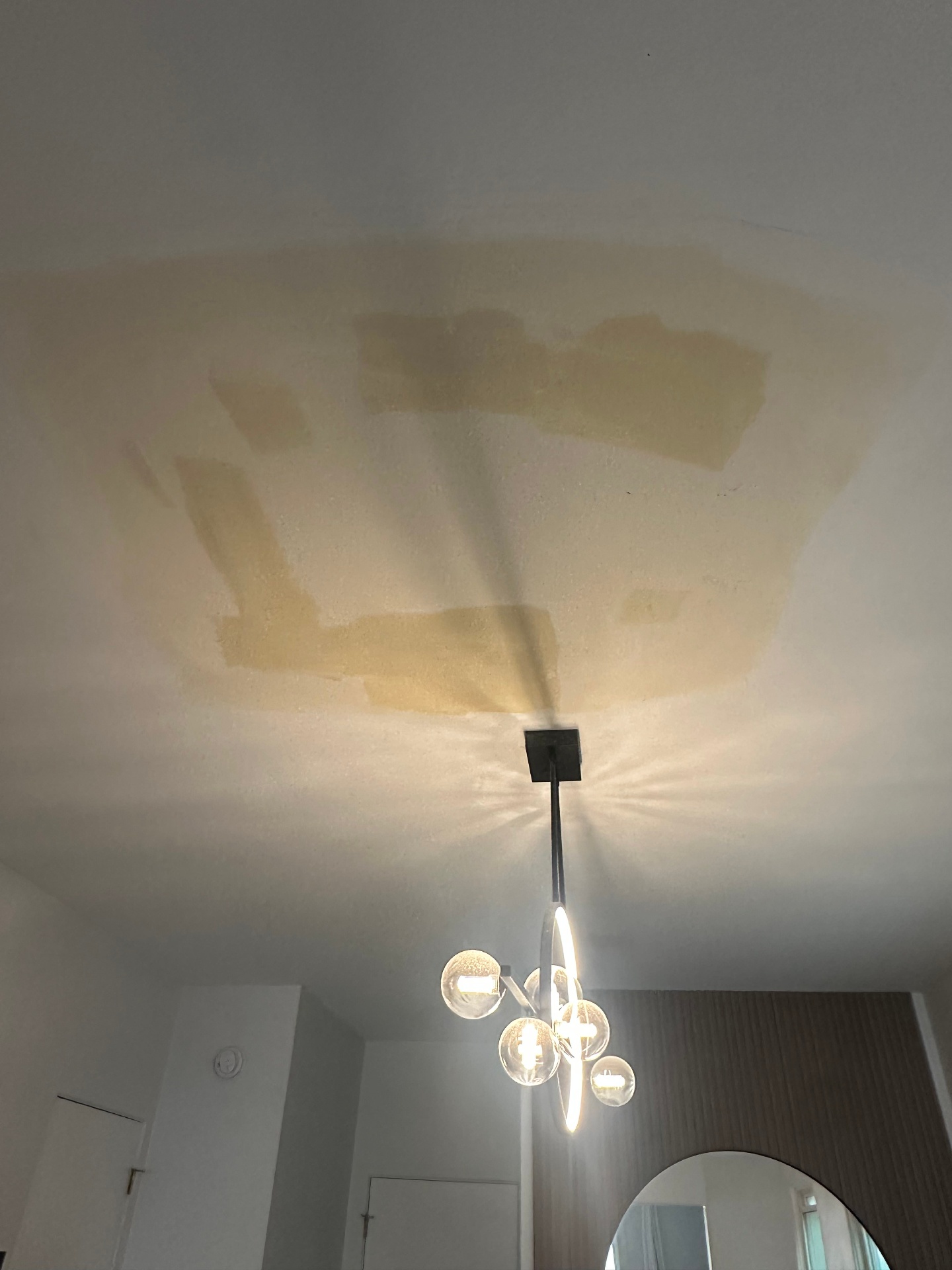
After a roof or plumbing leak, the first question is almost always the same: how long until the ceiling is dry enough to work on? In Illinois homes the honest answer is 3 to 7 days with active drying, longer without it - and the calendar matters far less than what a moisture meter says. This guide covers realistic drying times, how to confirm the cavity is dry, and when water damaged ceiling repair means cutting the board out instead of drying it in place.
How long does it take to dry a ceiling after a water leak?
- Small stain, one-time leak, fan and dehumidifier running: 24-72 hours
- Saturated area under 4 square feet with insulation above: 3-5 days
- Larger saturated area or blown-in insulation holding water: 5-10 days
- No active drying equipment, closed room, humid Illinois summer: 2-3 weeks or never fully dry
Those windows assume the leak is actually stopped. Drying a ceiling under an active roof leak just moves water around.
How to tell when a wet drywall ceiling is really dry
Surface-dry and cavity-dry are different things. We take pin or pinless moisture-meter readings on the ceiling board and compare them against an unaffected area of the same ceiling. When the wet area reads within about 1-2 percentage points of the dry baseline for two consecutive days, the assembly is dry. Insulation above the board holds water far longer than the board itself, which is why a ceiling can feel dry to the hand and still be wet where it counts.
Does wet drywall always need to be replaced?
No. Board that got damp but kept its strength and plane usually dries, gets stain-blocking primer, and repaints fine. Board has to come out when it sags, feels soft or crumbly, the paper face has separated, joint tape has released, or the water came from a contaminated source such as a sewer backup. Those are structural and health calls, not cosmetic ones. Our how to fix a water damaged ceiling walkthrough covers the repair sequence step by step.
How to speed up drying a ceiling in an Illinois home
- Stop the source first - roof, supply line, drain, or an appliance above
- Pull down anything holding water: soaked insulation dries far slower than board
- Run a dehumidifier in the room, not just a fan; humid air will not absorb more moisture
- Move air across the ceiling plane with a box fan or air mover
- In winter, keep the room heated - cold air holds less moisture and stalls drying
- Open small inspection holes above the wet area so the cavity can breathe
Why mold risk drives the timeline
Mold can start in a wet ceiling cavity in roughly 24-48 hours. That is the real deadline, not the stain. If a ceiling has been wet for more than about two days with insulation above it, we usually recommend opening the affected section rather than betting on it drying clean - it is cheaper than remediating later. Illinois summer humidity, covered in our Illinois humidity and drywall guide, stretches every drying timeline.
Will the water stain come back after painting?
It will if the ceiling gets painted with standard latex over a dried stain. Water-soluble tannins bleed straight through. The fix is an oil-based or shellac stain-blocking primer over the full stain, then repainting the entire ceiling plane corner to corner so the sheen matches. Spot-painting a ceiling almost always leaves a visible halo.
When to call a drywall contractor instead of waiting
Call as soon as the ceiling sags, cracks along a seam, or the stain keeps growing after the leak is fixed. Those signal that the board has lost strength or that water is still tracking in from somewhere else. We serve Plainfield and the surrounding area - see drywall repair in Plainfield or drywall repair in Naperville for local scheduling.
Frequently Asked Questions
How long does it take to dry a ceiling after a water leak?
+
With a dehumidifier and air movement, most Illinois ceilings dry in 3-7 days. Small one-time leaks can dry in 24-72 hours. Without active drying, a saturated ceiling can take two to three weeks or never fully dry.
How do I know if my ceiling is dry after a leak?
+
Compare moisture-meter readings on the wet area against an unaffected part of the same ceiling. When the readings are within 1-2 points for two consecutive days, the assembly is dry. Touch alone only tells you the surface is dry.
Does a wet drywall ceiling always need to be replaced?
+
No. If the board kept its strength and plane, it can dry, be primed with a stain blocker, and be repainted. It must be replaced if it sags, feels soft, the paper face separated, the tape released, or the water was contaminated.
How fast can mold grow in a wet ceiling?
+
Mold can begin in about 24-48 hours in a wet cavity. If a ceiling has been wet longer than two days with insulation above it, opening the section is usually safer and cheaper than waiting to see.
Should I poke a hole in a bulging ceiling?
+
If a ceiling is bulging with trapped water, draining it from a small hole into a bucket prevents a larger collapse - but only once the room below is clear and the power to any fixture in that ceiling is off.
Why does the water stain come back after I paint?
+
Standard latex does not block water-soluble stains. Use an oil-based or shellac stain-blocking primer over the whole stain, then repaint the entire ceiling plane so the sheen matches.
Do you dry ceilings or only repair them?
+
We handle the drywall side: verifying with a meter that the cavity is dry, removing compromised board, rebuilding, texture matching, priming, and repainting the ceiling plane.