
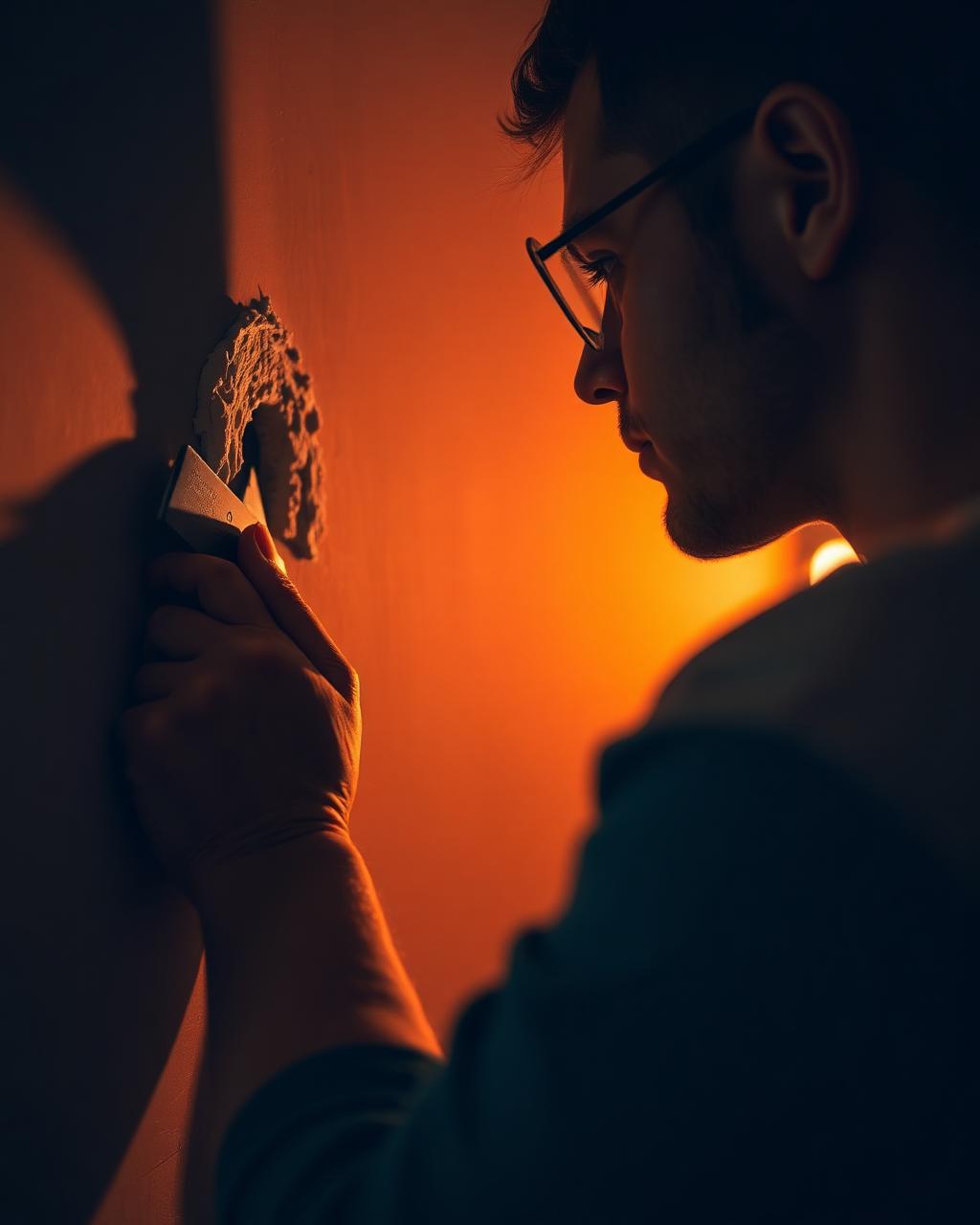
Drywall holes are one of the most common repairs on any Illinois home - a moved shelf, a doorknob impact, a settling crack, a shelving anchor pulled through. Some are honest DIY projects. Some are the reason your patch reads as a shadow under every lamp for the next decade. This guide walks through both, so you know which one you're looking at. For anything beyond a nail hole, our drywall repair service handles it end-to-end across Illinois.
Step 1: Size the hole - it drives the whole repair
Drywall hole size determines both the technique and whether it's a real DIY project:
- Under 1" (nail hole, small screw hole) - lightweight spackle, single coat, sand, prime, paint. Honest DIY.
- 1" to 4" (fist-sized to small drywall knife) - self-adhesive metal patch or California patch. Doable DIY with patience.
- 4" to 12" (doorknob blowout, medium impact) - backer + drywall piece + taped edges + 3 coats. Borderline DIY.
- Over 12" (large impact, water damage, section replacement) - full section cut back to studs. Call a pro.
Step 2: DIY method - the California patch for holes 4-12 inches
The California patch (also called a butterfly patch) is the technique to know for medium holes without opening the wall to studs. Cut a piece of drywall roughly 2" larger than the hole. Score the back of the patch and snap off the outer 1" of gypsum, leaving 1" of paper facing all the way around. Trace the paper flange against the wall, cut the wall opening to match the gypsum core, insert the core into the hole, and mud the paper flange flat against the surrounding wall. Three coats of joint compound feathered wider each time (8", 12", 16") - then sand, prime, and paint. Illinois humidity swings mean full drying time between coats matters here.
Step 3: When a drywall hole needs to be cut back to studs
Any hole larger than 12", any hole where the drywall around the edge is soft or water-damaged, and any hole where you can see mold on the paper facing needs to be cut back to solid framing on both sides. That's a stud-to-stud cut, a new drywall piece screwed to the studs, mesh or paper tape on all four seams, and three coats of feathered mud. This is where DIY often goes sideways - the tape lifts, the mud cracks, or the patch telegraphs because the mud coats weren't feathered wide enough.
Step 4: Match the texture - the DIY killer
This is the step that makes 90% of DIY drywall patches look like patches. If your Illinois home has smooth Level 4 walls, sand the patch flush and prime - a smooth patch on a smooth wall is doable. If your walls have orange peel, knockdown, or skip-trowel texture, matching by hand or with a rental hopper gun is genuinely hard on the first try. Full technique breakdown lives in our matching drywall texture in older homes guide, and our drywall texture matching service handles the ones that outrun a rental gun.
Step 5: Prime the patch - never skip this
Bare joint compound absorbs paint at a completely different rate than the surrounding painted wall. Even a perfect patch with matched texture will telegraph under paint if you don't prime it first. Use a drywall-specific primer or a PVA. This one step separates most DIY patches from professional Illinois patches.
When to call an Illinois drywall pro instead of DIY-ing the patch
- Any hole where the drywall is soft or water-stained around the edges.
- Ceilings - gravity, dust, and matching ceiling texture are all harder from a ladder.
- Real estate photos, insurance photos, or a pre-showing timeline.
- Older Illinois plaster walls (Lake Forest, Highland Park, Lake Bluff) - plaster patches need different technique.
- Any hole larger than a doorknob impact where the wall has heavy texture.
- Recurring cracks - if you've patched the same spot twice, the underlying cause needs diagnosis.
For any of those situations, our drywall repair cost in Illinois pillar breaks down what a professional patch should cost - and why cheap quotes almost always skip a step that shows up in month three.
How Illinois humidity affects a drywall patch
An Illinois home cycles from 65% relative humidity in July to 20% or lower in January when forced-air heat runs constantly. That swing moves framing and opens seams. On patches near cathedral ceilings, above doors and windows, or on additions - places framing moves the most - we use paper tape plus setting-type compound rather than mesh and premixed mud. Mesh alone flexes and cracks come back. The right compound is why professional patches hold across Illinois freeze-thaw cycles.
Frequently Asked Questions
Can I patch a drywall hole myself?
+
Small holes (under 1") are honest DIY with spackle. Medium holes (1-4") are doable with a self-adhesive patch. Anything larger than a doorknob impact - especially on textured walls or ceilings - is usually worth having a pro handle so it doesn't telegraph under every lamp.
What's the best way to patch a fist-sized drywall hole in an Illinois home?
+
The California patch (butterfly patch) - a drywall piece with the outer gypsum scored off, leaving 1" of paper facing that gets mudded flat against the surrounding wall. Three coats feathered wider each time, sand, prime, paint.
Why does my DIY drywall patch show under the ceiling light?
+
Usually one of three things: mud coats weren't feathered wide enough (8", 12", 16" minimum), the texture doesn't match, or the patch wasn't primed. Bare joint compound absorbs paint differently than painted wall.
How long should I wait between drywall mud coats in Illinois?
+
24 hours between coats in Illinois in most seasons. Winter with forced-air heat and low humidity dries mud faster - as little as 12 hours. Summer with 65% humidity can push it to 36 hours. Rushing it is how patches crack later.
Do I need to prime a drywall patch before painting?
+
Yes, always. Bare joint compound absorbs paint at a different rate than the surrounding painted wall, so the patch reads as a shadow under any decent light. Use a drywall-specific primer or PVA.
How much does a professional drywall patch cost in Illinois?
+
Small hole patches (fist-sized or smaller) typically run $180-$525 all-in across Illinois including texture match and paint prep. Larger patches or ceilings run higher - full ranges on our drywall repair cost in Illinois pillar.