
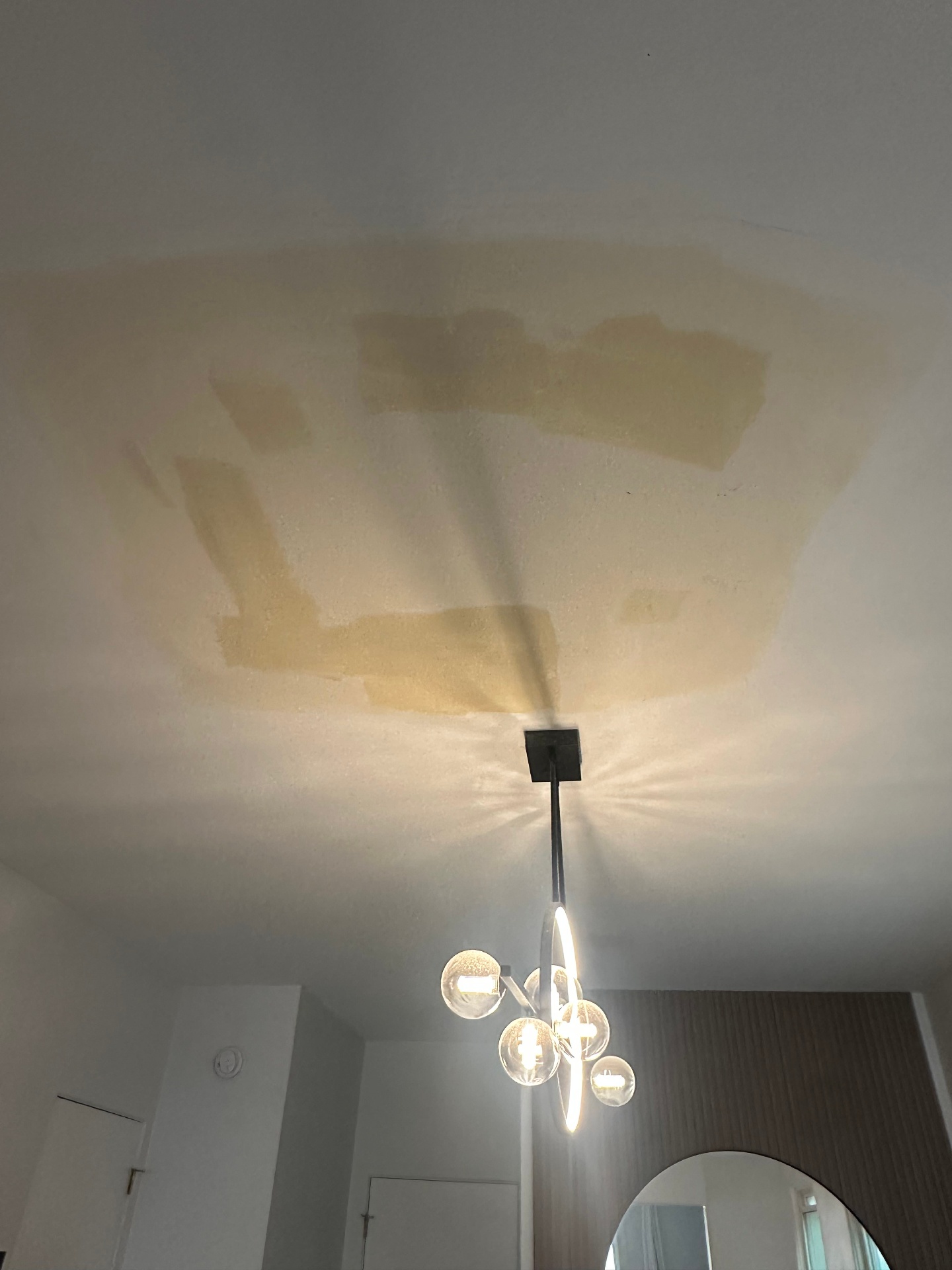
Mold on drywall is a moisture question first and a drywall question second. Gypsum board itself is not food for mold - the paper facing and the dust on it are. That distinction decides whether you wipe the wall down or cut the section out, and it is the first thing we look at on any water damaged drywall repair call in Illinois.
How to tell surface mold from mold behind drywall
- Surface growth: fuzzy or speckled colonies on paint or paper, board still firm and flat when pressed
- Cavity growth: musty smell with little visible staining, or a stain that keeps returning after painting
- Soft, spongy, or crumbling board means water got behind the paper - cleaning will not save it
- Bubbling or peeling paint in a straight line usually traces a leaking pipe or a roof path above
- Dark rings with a hard edge that never grow are usually old water stains, not active mold
If the board flexes under thumb pressure, the gypsum core has lost strength and the section gets replaced no matter how the surface looks.
What causes mold on drywall in Illinois homes?
Our humidity cycle does most of the work. Summer dew points push indoor humidity past 60% while basement walls sit at ground temperature, so condensation forms on the coolest surface in the house. Add a slow supply line, a failed shower pan, or grading that sheds water toward the foundation and you have a continuous moisture source. Read more in our guide to Illinois humidity and your drywall.
Can you clean mold off drywall yourself?
Sometimes. Public health guidance from the EPA on mold cleanup treats a patch under roughly 10 square feet on a hard, non-porous, still-solid surface as a homeowner-scale job. Ventilate, wear an N95 and gloves, use detergent and water rather than bleach on porous surfaces, and dry the area completely. What matters more than the cleaning product is fixing the moisture source - clean a wall and leave the leak and it grows back within weeks.
When moldy drywall has to be cut out and replaced
- Growth larger than about 10 square feet, or repeating in the same place after cleaning
- Board that is soft, sagging, delaminating, or stained through to the back side
- Mold traced into insulation or framing behind the board
- Contamination from sewage or flood water, which is never a clean-and-keep situation
- Ceilings after a plumbing leak, where the cavity stays wet long after the surface dries - see how long it takes to dry a ceiling after a water leak
Our replacement sequence is containment and negative air first, cut back to the nearest framing member on each side, remove wet insulation, dry and verify with a moisture meter, then hang mold-resistant board, tape, and finish to match the room.
Should you use mold-resistant drywall in basements and baths?
Yes in wet zones. Paperless and fiberglass-faced boards remove the paper facing mold feeds on, and cement board belongs behind tile in showers. It is standard on our basement drywall work. It is a second line of defense though - a vapor-managed wall assembly, a dehumidifier holding 45 to 50% relative humidity, and working gutters matter more. Board options are compared in our post on types of drywall for Illinois homes.
Seeing mold after a leak in the southwest suburbs? We handle cutback, drying verification, and finish repairs in Plainfield, Bolingbrook, and Joliet.
Frequently Asked Questions
Can mold on drywall be cleaned or does the drywall need replacing?
+
Surface mold on a small area of firm, painted board can be cleaned with detergent and water once the moisture source is fixed. If the board is soft, stained through, or the area exceeds roughly 10 square feet, the section should be cut out and replaced.
How do I know if there is mold behind my drywall?
+
A persistent musty smell with little visible staining, stains that return after painting, bubbling paint in a line, or board that feels soft when pressed all point at growth inside the cavity rather than on the surface.
Is bleach the right way to clean mold off drywall?
+
Not on porous surfaces. Bleach leaves water behind and does not reach into paper facing. Detergent and water plus thorough drying is the recommended approach, followed by fixing whatever caused the moisture.
What causes mold on basement drywall in Illinois?
+
Summer condensation on cool below-grade walls, indoor humidity above 60%, foundation seepage, and grading or downspouts that dump water at the wall. Holding 45 to 50% relative humidity with a dehumidifier stops most of it.
Does mold-resistant drywall prevent mold?
+
It removes the paper facing mold feeds on, which slows growth substantially, but it will not stop mold if liquid water keeps entering the assembly. It is a backup to moisture control, not a replacement for it.
How much does it cost to replace moldy drywall?
+
In Illinois, a contained single-wall section with insulation removal, drying verification, mold-resistant board, and finish typically runs $650 to $2,200 depending on access and square footage.